Op-Ed by Francesca Porcelli, Policy Officer for Social and Economic Development, EU Delegation to Albania
Albania has considerable raw-material potential and is attracting interest from a growing number of potential partners. As competition for critical raw materials intensifies, Europe therefore faces an important question: what would make the EU the partner of choice?
The answer lies in an advantage that goes beyond any individual investment or extraction project. For Albania, the prospect of EU membership means that cooperation on raw materials can form part of a much deeper process of economic and political integration. By approaching Albania as a future economic and political peer, Europe can build the trust and long-term commitment needed to strengthen institutions, develop industrial capacity and integrate the country more closely into European value chains. This is the basis for a partnership that can create lasting value for both sides.
The EU needs to offer something different. It must be focused on long-term industrial integration — the ultimate goal is not merely to extract the materials, but to build an ecosystem that can create advantages for both sides.
Francesca Porcelli, Policy Officer for Social and Economic Development, EU Delegation to Albania
Making Europe’s advantage count
For this approach to succeed, Europe’s political advantage needs to be backed by a credible commercial offer. Albania should be able to participate in the value created from its resources, while European industry gains access to more secure and diversified supply chains.
One of the most important elements is certainty of demand. Project developers need confidence that materials produced in Albania will be purchased and integrated into European supply chains. Long-term offtake agreements with European industrial buyers can provide that confidence. EU mechanisms under the Critical Raw Materials Act, alongside the emerging European Critical Raw Materials Centre, can help connect project promoters with European industrial buyers seeking secure, near-shored supply.
A stronger European offer also means helping Albania create the conditions for investment. Its fragmented permitting system needs to become more streamlined and predictable, while remaining aligned with EU standards. Its technology and capacity building need to be upgraded, for instance, there is a shortage in Albania of certified laboratories for analysis, meaning most samples must be sent abroad and the country cannot readily verify its own resources. This creates a significant credibility gap for investors. Where companies cannot carry project risks alone, European financial institutions can also step in through financial guarantees, the Global Gateway and instruments under the Critical Raw Materials Act.
The foundations for this partnership are beginning to emerge. In 2024, Albania’s Ministry of Infrastructure and Energy partnered with EIT RawMaterials to establish a Regional Innovation Centre in Elbasan, the first of its kind in the Western Balkans. The Centre provides technical expertise, connects Albanian projects with European partners and supports alignment with EU environmental, social and governance standards. Geological studies produced with support from the EU Delegation have also fed into Albania’s National Mining Strategy for 2026–2040. These efforts, while still at an early stage, show strong commitment and are laying the foundations for long-lasting industrial development.
From potential to investment
One of the most immediate priorities is making Albania’s geological potential more visible and credible to investors. Much of the country’s geological data remains organised under the old Soviet classification system and is available only in Albanian, while priority materials require further exploration to establish their economic viability.
Converting this data into internationally recognised frameworks and publishing it in English would make Albania’s potential far more accessible to European investors. Combined with new exploration campaigns for selected materials, it could provide the ground-level validation needed to turn geological potential into bankable projects. The Albanian Government and national agencies in the sector have already begun addressing the gap.
The potential is undeniable. But potential is not enough when we need to compete.
Francesca Porcelli, Policy Officer for Social and Economic Development, EU Delegation to Albania
Albania’s progress towards EU accession is already contributing to a more stable investment environment, although major private investment in mining and refining has yet to follow. Investors are still looking for streamlined permitting, clearer geological mapping and concrete local infrastructure before committing significant capital.
Europe has an important advantage in Albania, but making that advantage count requires matching the wider accession relationship with practical industrial cooperation. European demand, investment and expertise can help turn Albania’s geological potential into viable projects, while stronger institutions and deeper integration can ensure that Albania shares in the value they create.
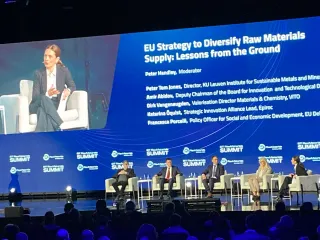
This Opinion piece is based on comments made by Francesca Porcelli during the panel discussion “EU Strategy to Diversify Raw Materials Supply: Lessons from the Ground” at the EIT RawMaterials Summit 2026. The views expressed in this article are those of the author and do not necessarily reflect the views or position of EIT RawMaterials.
This article is part of our EIT RawMaterials Summit Op-Ed series. Read all other Op-Eds here