By Jorgina Akushika, Mining Sensor Application Project Manager, Spectral Industries
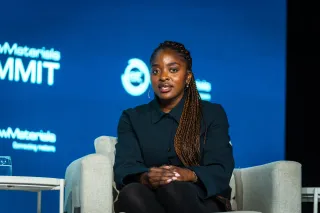
Jorgina Akushika at the EIT RawMaterials Summit 2026.
I'm Namibian, and mining was never a hard choice for me. We have abundant mineral resources, and the industry has always represented real opportunities where I'm from. I studied Geology and Atmospheric Science at the bachelor's level and then went to work at a mine. One day, my manager handed me the baton: "You'll be in charge of the exploration drilling campaign."
Looking back, that was a defining moment, not because of the technical work itself, but because I had a manager who genuinely believed in me. Opportunity, I've come to realise, is the real deciding factor in whether young professionals build a career or stall out.
After that, I packed up my life and moved to Europe to pursue an EIT Master’s degree in Sustainable and Innovative Natural Resource Management (SINReM), a programme that took me through leading universities in Sweden, Germany, and Belgium. It was there that I was truly introduced to the European materials sector, and where I learned that Europe is good at developing technology that can transform mining and the broader materials value chain.
Today, my work sits at the intersection of geology, a field I'm deeply passionate about, mining technology, business development, and leadership. The question that drives me every day is simple: How do we use technology to make the industry we love more efficient, and make sustainability meaningful, not just a buzzword we reach for?
What my generation expects
For me, one of the biggest expectations is opportunity — to learn, to contribute, to grow. That starts with mentorship, but true mentorship has to mean more than just advice.
Good mentors help young professionals see that mining isn't the dirty, tunnel-and-hard-hat industry it's often imagined to be. It spans technology, sustainability, startups, academia, business development, and more. The range of what this field can be is genuinely vast.
From my manager in Namibia to my managers here in the Netherlands, mentorship has meant being handed real opportunities to voice my thinking, which I am grateful for, and having my technical judgment factored into decisions, not just heard politely.
But mentorship also means skills transfer. Young people want to work in spaces where leaders are genuinely willing to teach and nurture those they lead. It starts with leaders identifying talent within their environment and deliberately deciding to pass on a skill.
It also means amplifying the impact young professionals make, so they stay inspired to bring ideas forward. That only happens when we have a genuine seat at the table, one where we are trusted to shape technical discussions, challenge ideas, and influence decisions.
The raw materials industry has changed significantly over the past 10 to 15 years. Performance standards are higher, and as a result, the expectations of young professionals are also higher. To attract and retain talent in this field, we need to create environments that are diverse and inclusive across age, gender, race, and skill sets. This creates better spaces where more balanced and optimal decisions can be made.
We also expect workplaces where people actually want to stay. The era of a seven-figure salary buying loyalty is over. Young professionals want meaningful work, healthy environments, and a sustainable pace, and we want to know the organisations we work for and understand that we are accountable to society, not just to a balance sheet.
Where academia and industry must step up
We need to train young people to tackle the challenges the industry is actually facing, not just absorb theory. How do we extract critical raw materials more efficiently? What does sustainability mean beyond the buzzword? And how do we actually equip young professionals to solve those real-world problems, rather than simply describing them?
Within my own Master’s cohort, there were young professionals with genuinely innovative ideas for tackling real-world challenges. But there's still a gap in teaching people how to write a proposal that secures funding or pitch an idea convincingly. Given the right skills, young professionals could start building solutions much earlier.
Industry has just as much work to do. Anyone who's sat through enough summits and conferences has heard the same points echoed year after year. So, I ask myself: are we repeating ourselves because the goals we set were never realistic to begin with? And if so, why? Or is it because the collaborations we build with other parts of the world aren't genuinely reciprocal?
The gap is clear. If it weren't, we wouldn't still be having the same conversation. To address this, the industry must be accountable and transparent, and these conversations cannot take place inside an echo chamber. Academia and industry are not separate islands, either. They need to work together if we are ever going to bridge that gap.
Finally, when we talk about "the industry," that includes us young professionals. We are not bystanders; we are co-participants. The onus is on us to show up when we are given the chance to contribute to the progress we are all so passionate about.
Jorgina Akushika is a Mining Sensor Application Project Manager at Spectral Industries. This article is based on her remarks during the panel “The Future Workforce: What Europe’s Next Generation Expects from the Materials Industry” at the EIT RawMaterials Summit 2026. Find out more here