Partner Day 2026: Partners at the heart of what comes next
Partner Day 2026 brought 85 partners from across industry, academia and research together in Brussels to share expertise, tackle common challenges and explore how collaboration across the EIT RawMaterials community can create greater value.

Across two days at the KBR Museum in Brussels, partners shared how they are using the EIT RawMaterials network and services to open new opportunities, while bringing their own experience and expertise to the challenges facing Europe’s raw materials sector.
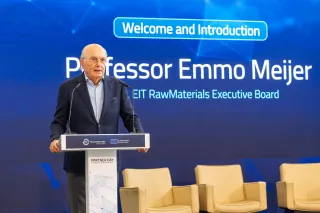
The importance of that expertise came through strongly in the opening discussion between Christian Ehler, MEP and the European Parliament's lead rapporteur for the next Framework Programme (FP10), and EIT RawMaterials CEO and Managing Director Bernd Schäfer, on moving Europe's raw materials ambitions from policy to delivery.
Ehler reminded partners that EIT RawMaterials was created because Europe needed the expertise within this community — expertise that now puts it “in the centre of the discussion” as the proposed European Critical Raw Materials Centre takes shape. He pointed to the Parliament's proposal for a €10 billion Critical Raw Materials Fund as evidence of unusually fast institutional movement, while stressing that neither Parliament, Commission nor Member States currently hold the market expertise needed to set up its operations.
Schäfer pushed the conversation beyond individual projects toward a quantified picture of what Europe needs across whole value chains, pointing to the continent’s "missing midstream" in processing and refining as a critical gap. Without it, he argued, there is no downstream, no competitiveness and no real innovation base.
The discussion reflected themes from EIT RawMaterials' position paper on the proposed Centre, including the need to connect Europe's strategic ambitions more closely with practical industrial delivery.
A CRMF connection grows into a wider partnership
Strengthening Europe's value chains also has an international dimension. Peter Tom Jones, Director at KU Leuven, described how a connection made through the Critical Raw Materials Facility (CRMF) has grown into a wider collaboration to recover rare earth elements from Uzbekistan's uranium deposit.
Introduced by the CRMF during EU Raw Materials Week 2025, KU Leuven and Uzbekistan Technological Metals Complex (UzTMK) signed a research contract worth just under €300,000 within three weeks — a record time to signature for KU Leuven.
Less than a year on, the partners have developed a proof-of-concept rare-earth recovery process and are now looking at upscaling and piloting, with KU Leuven, UzTMK and Tashkent State Technical University laying groundwork for a joint Hydrometallurgy Research Centre.
Better intelligence for better decisions
Partner Day also looked at how better market intelligence can help partners navigate increasingly complex raw materials markets.
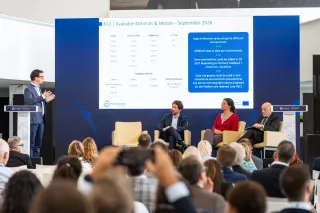
Launched in June, M2i – the Minerals & Metals Intelligence Platform brings trusted data and insights across commodities, trade, production and value chains together in one place, with partners helping shape its development.
Antoine Delavenne, Head of Market & Economic Analysis at Eramet, demonstrated M2i using graphite as an example. He explained that even with a substantial in-house market analysis team, exploring less familiar commodities can require hours of research across multiple sources.
Using M2i, he was able to replicate a graphite market analysis that had previously taken hours in around five minutes, quickly accessing information on trade, production and potential opportunities.
Delavenne and Alessandra Hool, CEO of the ESM Foundation, also highlighted priorities for M2i’s further development, including stronger visibility across entire value chains and more information on recycling and secondary raw materials.
David Merchin, EIT RawMaterials' Head of Business Intelligence, confirmed a battery value-chain dashboard is already in development, with a more complete rare-earths analysis expected early next year and copper, tungsten and aluminium among the next priorities.
Closing Europe’s skills gaps
Stephanie Levy, Director of Education and Skills at EIT RawMaterials, shared findings from a skills needs analysis covering 33,000 job postings, more than 40 EU projects and 30 organisations. It identified more than 350 distinct skills gaps, including AI and machine learning, automation and robotics, circularity and advanced metallurgy.
The findings reinforced the importance of closer links between education and industry, a priority for the European Raw Materials and Advanced Materials Academies. Levy outlined how partners can contribute to the Academies as learning content providers and subject-matter experts, with further information now available through the new European Raw Materials Academy landing page .
Partners also shared their experience of bridging those gaps. Xcalibur described how bringing AI and data specialists together with geologists and geophysicists is helping traditionally separate disciplines work more closely together. Monolithos, a partner in the winning 2025 Eureka Spark consortium under the EIT Higher Education Initiative (HEI), highlighted the benefits of postgraduate students completing theses within companies, giving them practical industry experience while encouraging closer collaboration with universities.
Working together on shared challenges
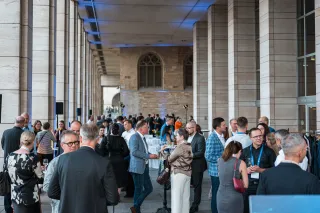
The Strategic Impact Network Groups (SIGNs) were a major part of the programme during Partner Day.
Following an overview from Roland Gauß, Innovation and Product Development Director at EIT RawMaterials, partners in the Rare Earth Elements & Magnets, Green & Circular Metals and Battery Materials SIGNs shared progress and used reverse pitches to put real industry challenges to the wider audience. Partners also got a first look at the new Exploration & Mining SIGN, ahead of its October launch, extending the SIGN model into another strategically important part of the value chain.
Partner Day also welcomed seven new partners into the community, bringing further expertise and fresh opportunities for collaboration to the network.
Interested in becoming a partner? Find out more here
Find more partner success stories here