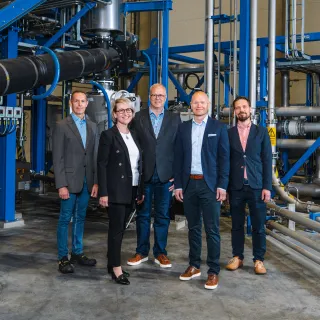
SCIONb demonstrates the power of collaboration in building better batteries
Led by PCC Thorion, the team behind the EIT RawMaterials-supported SCIONb project has been nominated for the EIT Innovation Team Award for its work developing next-generation battery materials.

Europe’s growing battery industry needs not only higher-performing materials, but more resilient and sustainable supply chains. Graphite remains the standard anode active material in lithium-ion batteries, with Europe heavily reliant on imports.
Supported through an EIT RawMaterials KAVA call, the SCIONb project brought together PCC Thorion, Fraunhofer ISE, the University of Duisburg-Essen and the University of Freiburg to address that challenge. Each partner contributed different expertise, spanning nanomaterials, battery electrolytes, silicon-carbon composites and industrial raw materials.
Together, they developed and scaled a silicon-carbon composite anode material alongside complementary electrolyte additives – technologies designed to store more energy using less material while improving battery performance.
Breaking out of the bubble
The SCIONb project built on research and expertise already developing across the four organisations, but brought those capabilities together in one team. The challenge was to turn that combined knowledge into technology that could work not only in the laboratory, but at industrial scale.
For Enrico Roicke, Managing Director of PCC Thorion, one of the project’s most important lessons was the value of working beyond organisational boundaries.
You usually work in your bubble, especially if you have different entities and institutes together. But being able to share knowledge and analytical equipment across the borders of your group really opens up the door and brings the project forward.
Enrico Roicke, Managing Director of PCC Thorion
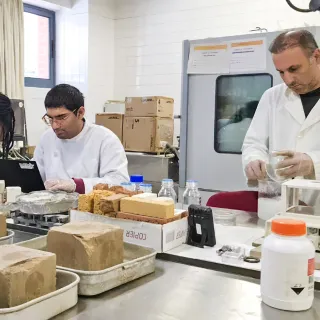
That collaboration became particularly important when several early production approaches did not perform as expected during scale-up and had to be abandoned. Rather than tackling those setbacks separately, the partners worked through them together, testing multiple approaches using different raw materials and process variations.
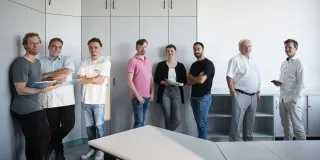
PCC Thorion team with Enrico Roicke
The results gave the team confidence not only in the material itself, but in a production process flexible enough to work with different raw materials and potentially support future generations of battery materials.
Better batteries with less material
One of SCIONb’s key developments was its silicon-carbon composite anode material. Silicon can store significantly more lithium than graphite, but its tendency to expand and contract
during charging can cause it to degrade. SCIONb’s approach combines silicon with carbon, alongside specially developed electrolyte additives designed to improve stability and battery lifetime.
Using less material to store the same amount of energy means you can make a battery smaller or lighter without losing capacity or keeping it the same size and increase its range. Together with our electrolyte additives, we can also improve battery performance and enable faster charging.
Enrico Roicke, Managing Director of PCC Thorion
According to Enrico, one kilogram of the team’s silicon-carbon composite could replace around four to five kilograms of graphite. The team also estimates that the material could have an 80–90% lower CO₂ footprint than graphite, due to both the smaller quantity of material required and the raw materials used.
From research towards commercialisation
Battery materials represented a new business area for PCC when SCIONb began, but the EIT RawMaterials project framework helped the company combine its industrial perspective with specialist battery research from the outset.
“We would have taken a more industry-led approach, but I’m not sure we would have had access to the same breadth of knowledge,” he says. “Bringing in research institutes with experience in the battery field gave us greater confidence in the project and helped us scale the technology.”
EIT RawMaterials also supported the project as it evolved, including enabling the team to extend its initial work to scale up the complementary electrolyte additives.
One of the strengths of the EIT RawMaterials approach is that it isn’t simply about funding R&D and then putting the results in a box. There was a clear focus on commercialisation from the beginning.
Enrico Roicke, Managing Director of PCC Thorion
That focus has helped the team move beyond technical development and build connections across Europe’s battery industry as it works towards bringing the technology closer to market.
Recognising the team behind the technology
For Enrico, the Innovation Team Award nomination is also an opportunity to recognise the people behind the technology.
“A lot of development work happens out of sight, in laboratories and industrial facilities, and it’s never a one-person job,” he says. “There are many people behind a new technology who are rarely seen — but one of the things that motivates us is knowing that one day you might drive an electric car containing a material you helped develop, and because of that work, it has more range or charges faster. This nomination is a chance to recognise that whole team and make their work visible.”
The team behind SCIONb has been nominated for the EIT Innovation Team Award. You can vote for the team to receive the public vote award. Celebrate with us the researchers and industry partners in the EIT RawMaterials community working to strengthen Europe’s battery value chain. Find out more about the EIT Award.
Find out more about our other EIT Award Nominees 2026 here: