The return on critical minerals investment should be resilience, not profit
By Stefan Müller, CEO, DGWA

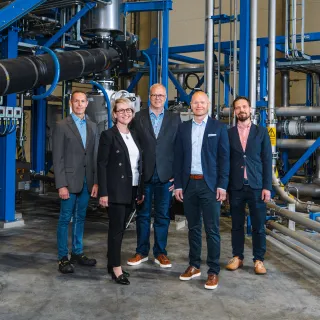
Stefan Mueller , CEO, DGWA during the EIT RawMaterials Summit 2026.
Europe is finally beginning to put serious public money behind critical raw materials. Germany's KfW-led Rohstofffonds, Italy's Fondo Nazionale del Made in Italy and France's InfraVia Critical Metals Fund all recognise that secure access to critical minerals has become a question of economic security as much as industrial competitiveness.
As these new investment vehicles begin operating, their success will inevitably be judged by whether they generate a financial return. But that applies the wrong standard. Private capital already finances commercially viable mining projects—and it does so effectively. If a project stacks up commercially, the market will find it. Public capital exists for a different purpose: to finance strategically important projects that markets alone cannot support. The return on those investments is resilience—diversified supply chains, preserved processing capacity, industrial capability and reduced strategic dependence.
Markets do not always reward strategic value
The challenge is that today's critical minerals markets no longer function like ordinary markets. China has spent decades building dominant positions across mining, processing and refining, giving it the ability to keep prices below the cost of Western producers and squeeze competitors out of the market. Projects that are strategically indispensable for Europe can therefore appear commercially unattractive, not because they are poorly managed, but because the market itself has been distorted.
This is precisely where governments have a different responsibility from private investors. A private investor quite rightly asks whether a project will generate a competitive return. But governments have to ask whether an investment preserves capabilities that Europe cannot afford to lose, keeps production alive, and reduces dependence on suppliers that have already demonstrated their willingness to weaponise critical raw materials.
The consequences of applying purely commercial logic are already visible across Europe. Since 2021, soaring energy costs have forced the closure or curtailment of nearly half of Europe's primary aluminium smelting capacity. Lead smelters face similar pressures, despite producing antimony, an essential material for defence. Once these facilities close, they rarely reopen. Skilled workers move on, suppliers disappear, and decades of industrial expertise are lost. Capital can usually be recovered, but industrial capability often cannot.
That is why there is an important distinction between an investment failure and a strategic failure. Governments should not preserve every loss-making project, but they should be prepared to support projects that create or maintain genuine strategic capability where markets no longer can. Europe's first industrial-scale rare earth magnet factory in Narva, Estonia, illustrates the point. It required public backing despite producing materials that are indispensable for electric vehicles, wind turbines and defence technologies. The missing profit was not the project's failing—it was the consequence of competing against a market dominated by China.
Turning partnerships into investment
Europe also needs to think differently about how it works with trusted partners. Australia and Canada have decades of experience supporting strategic mining projects and are already investing public money in developing their own critical mineral industries. Rather than repeating years of technical assessments and due diligence, Europe should be prepared to co-invest alongside trusted allies, securing long-term access to supply while sharing both expertise and risk.
The political frameworks for doing so already exist through raw materials partnerships and bilateral agreements. What has been missing is a willingness to use them as investment platforms rather than diplomatic declarations. Strategic partnerships should be backed by strategic capital.
Ultimately, Europe's public investment funds should be judged against the purpose they were created to fulfil. If they are assessed solely on whether they maximise financial returns, they will inevitably behave like private investors and finance many of the same projects the market would have supported anyway.
Public investment should instead be judged by the resilience it creates. Insurance policies are not measured by the profit they generate, but by whether they provide protection when it matters most. Europe's critical minerals strategy deserves to be assessed in exactly the same way.
This Op-Ed was adapted from Stefan’s contributions during the panel discussion “Show me the money: Can Europe’s national raw materials funds deliver at scale” at the EIT RawMaterials Summit, 2026. Find out more about the Summit here.