Media Lario: taking precision engineering from space to next-gen batteries
Through a consortium supported by EIT RawMaterials, Italian SME Media Lario is using decades of expertise in space optics to advance the development of sustainable zinc batteries.

Illustration of a satellite carrying a space-based optical system
From building optics that operate deep in space to developing next-generation zinc-based batteries for energy storage, Media Lario is applying decades of precision engineering and metallurgical expertise to one of Europe’s biggest industrial challenges: creating sustainable alternatives to lithium-based batteries.
Through a two-year consortium supported by €1.5 million from EIT RawMaterials, Media Lario and its partners advanced their zinc-based battery technology from an initial concept (TRL 2) to laboratory validation (TRL 4).
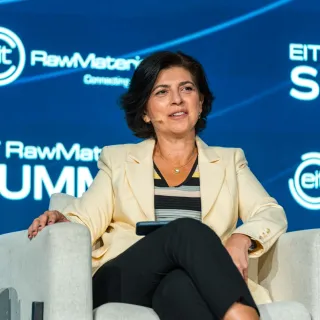
Media Lario’s journey highlights the importance of cross-sector innovation in strengthening Europe’s industrial leadership. We are proud to have supported the company in unlocking the broader potential of its technology and look forward to continuing this collaboration through our network, enabling new strategic partnerships, accelerating market adoption, and reinforcing Europe’s competitiveness in key industrial value chains.
Valentina Anzoletti, Business Development Manager, EIT RawMaterials
Our ambition is to become a key player, not only in advancing post-lithium technologies, such as zinc-based chemistries currently under study, but also in driving continuous innovation within Europe.
Jeff Lyons, CEO of Media Lario
From space telescopes to the first image of a black hole
Media Lario was founded in 1993 to develop highly specialised optics for the European Space Agency’s XMM-Newton X-ray space telescope. Its engineering team, headed by Chief Technical Officer Dr. Giuseppe Valsecchi, conceived of a special galvanic process to produce the optics, which are essentially mirrors with extremely precise and complex geometries. During the process, material is grown electrochemically onto a mould in a chemical bath. Once complete, the mirror is then lifted off from the mould for use in the telescope.
Since then, the company’s technology has powered major scientific and space programmes, contributing to some of the most significant scientific achievements of recent years. Its optics were used in several ground-based observatories1 involved in capturing the first-ever image of a black hole in 2019, including the Large Millimeter Telescope (LMT) in Mexico and the Atacama Large Millimeter/submillimeter Array (ALMA) in Chile. The company is now manufacturing optics for the ESA’s next-generation ATHENA X-ray observatory, scheduled for launch in the 2030s.
Built for extreme conditions
XMM-Newton, launched in December 1999, continues operating to this day without ever having been serviced, sitting at a point in space just over 1.5 million kilometres from the Earth or about 5 times the distance to the Moon.
The drive to make products that last in the harshest environments is part of Media Lario’s DNA, Lyons said, and it has led the company to ask where else that expertise could make a difference. Sustainable and resilient battery storage for energy grids could be a natural fit for its technology, the company has found, particularly as the world faces increasingly extreme climate conditions.
"We realised that this galvanic process of growing a mirror on a mould is, in effect, a battery operating in reverse." Jeff Lyons, CEO of Media Lario
Throughout the project, EIT RawMaterials provided vital support alongside their core financial funding, and it’s been very rewarding for us. Sharing a mutual vision to strengthen Europe’s industrial autonomy, we intend to take this collaboration further by participating in the next funding call to achieve our long-term goals.
Jeff Lyons, CEO of Media Lario
During the manufacturing process, ions contained in an electrolyte are deposited onto a metallic surface. From an electrochemical perspective, this resembles the charging mechanism of a battery.
From there, the question became which chemistry to pursue. As the energy storage industry looks for alternatives to conventional lithium-ion batteries, Media Lario decided to focus on zinc. "Zinc is very suitable to our processes, and it’s much more readily available, much more environmentally friendly and geopolitically friendly." adds Jeff Lyons.
For us, innovation is about challenging the status quo and pushing the boundaries of what’s possible.
Dr. Giuseppe Valsecchi, Chief Technical Officer, Media Lario
An enriching partnership
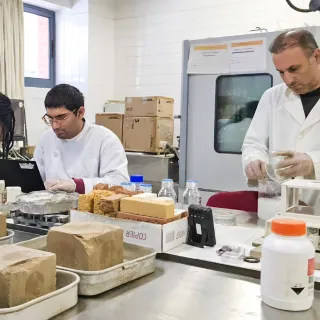
To advance the technology, Media Lario brought its core technical knowledge and industrialisation expertise to the EIT RawMaterials-supported consortium, while Politecnico di Milano, Italy’s largest technical university, contributed expertise in zinc electrodes. Slovenia’s National Institute of Chemistry (NIC) led development of cathodic electrodes, and the Slovenian National Building and Civil Engineering Institute (ZAG) coordinated the project and helped optimise its technical development.
Following the technical development, the consortium also carried out an economic evaluation to better understand the technology’s future market prospects. Media Lario is now looking at the next steps to move it towards industrial demonstration and eventually, commercial deployment.
For Media Lario, the project reflects the same drive that had led the company to develop its first optics for XMM-Newton.