DOK-ING Mining: Remote-Operated Machines for the World's Most Dangerous Mines
Supported by the EIT RawMaterials RIS KAVA Call, Croatian startup DOK-ING Mining is bringing a new generation of battery-electric, remotely operated mining equipment to market, helping strengthen Europe's future supply of critical raw materials.

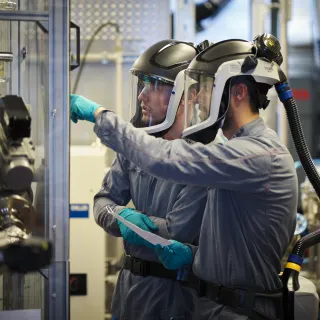
An engineer checks the DOK-ING battery-driven mining robot.
The metals powering Europe's green transition — platinum, copper and nickel, essential for electric vehicles and renewable energy technologies — are not always found in convenient places. Some deposits run through rock in passages so narrow that a person can barely crawl through them. For decades, extracting these narrow-reef deposits has meant manual mining in some of the industry's most dangerous conditions.
DOK-ING Mining, a Croatian startup backed by EIT RawMaterials, is working to change that. The startup has developed the world's first battery-electric, remotely operated mining fleet, which is purpose-built for ultra-low-profile hard-rock mining. It allows operators to control the machines safely from above ground while the machines carry out the dangerous work underground.
Operating the machines remotely is almost like playing a video game, except the technology is doing heavy work deep underground and keeping people out of harm’s way.
Luka Petro, CEO of DOK-ING Mining
From engineering project to commercial reality
DOK-ING has been developing robotic and remotely operated systems for hazardous environments for more than two decades. Introduced to EIT RawMaterials through the University of Zagreb's Faculty of Mining, Geology and Petroleum Engineering, it secured €3.6 million through the RIS KAVA 11 Call in 2023 to commercialise its NRE ElectRA technology. The funding supported final development to meet industry reliability standards and led to the creation of DOK-ING Mining as a dedicated subsidiary in April 2024, with EIT RawMaterials taking a minority equity stake.
The result is the NRE ElectRA fleet: five battery-electric machines — a dozer, drill rig, prime mover, support rig and the XLP Groundhog — designed for underground profiles between 0.9 and 1.7 metres where conventional equipment cannot operate. By enabling highly selective extraction, the fleet can increase ore grade by up to 70% while reducing waste rock by around 40%. Battery-electric operation also improves underground air quality and removes workers from hazardous environments entirely.
For a Croatian startup entering a sector in which the country has little established track record, the partnership with EIT RawMaterials provided more than funding. It also brought market insight, credibility and access to a European innovation ecosystem that helped accelerate commercialisation.
Luka Petro, CEO of DOK-ING Mining
Trials at the Tumela and Bokoni platinum mines in South Africa have also helped DOK-ING Mining refine the technology. Testing showed that upgraded machines, more experienced operators and improved training led to better performance and demonstrated that successful mechanisation depends on both the equipment and the people using it.
Mining the materials Europe needs
By making mining safer, cleaner and more selective, DOK-ING Mining is helping strengthen the supply of the critical raw materials Europe needs for its clean-energy transition.
One of the goals of the RIS programme is to help innovative companies recognise new opportunities and translate their expertise into solutions for Europe's strategic challenges. DOK-ING Mining is a great example of this: by building on decades of engineering know-how, the startup has developed a technology that can make critical raw materials extraction safer, more efficient and more sustainable.
Tina Benda, Regional Innovation Scheme (RIS) Manager, EIT RawMaterials
The startup's first commercial focus is on platinum group element mines in southern Africa, with plans to expand into other narrow-reef operations worldwide. A recent study by the University of Zagreb and DOK-ING Mining assessed 178 mines globally and identified strong potential for the technology in narrow copper and gold deposits across Europe, Africa and North America.
"We believe this technology will play a crucial role in securing the future supply of critical raw materials," Luka says. "By making mining safer, more efficient and reducing its environmental footprint, it has the potential not only to strengthen supply chains, but also to improve public acceptance of mining, accelerate permitting and bring new projects into production more quickly."