By Jessika Roswall, EU Commissioner for Environment, Water Resilience and a Competitive Circular Economy

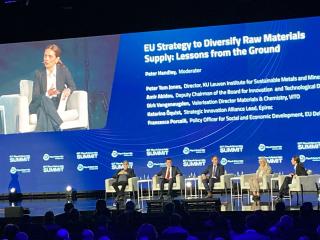
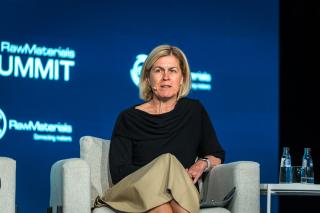
Jessika Roswall, European Commissioner for Environment, Water Resilience and a Competitive Circular Economy, at the keynote speech during the EIT RawMaterials Summit on 15 May 2025 in Brussels.
Global competition for raw materials has always defined international relations. Many centuries ago, the Romans clashed with Carthage over resources; in more recent history, we have seen the hunt for oil. Now, we are witnessing a new race—this time for the critical raw materials vital for digitalisation, the green transition, and the defence industry.
In the European Union and elsewhere, demand for critical raw materials is set to skyrocket. By 2050, the need for rare earth metals is expected to increase sevenfold, and lithium demand could multiply by as much as 21 times. All of this is happening in a context of uncertainty, instability, and shifting geopolitics. That’s why the theme of this year's EIT RawMaterials Summit—Race to 2030—could not be more fitting: this is indeed a race against time.
However, it isn’t just about who gets there first.
In a linear economy, access to critical raw materials determines how fast we can decarbonise and how competitive we will remain. Yet, the extraction and processing of natural resources account for over 55% of global greenhouse gas emissions and more than 90% of biodiversity loss and water stress impacts.
Importing these materials brings its own risks: long supply chains mean higher emissions, more vulnerability to disruption, and often lower environmental and social standards than those upheld in the EU. That’s why circularity must be at the heart of Europe’s strategy, and we must make the EU the world leader in circular economy by 2030.
The Clean Industrial Deal highlights that circularity brings competitiveness and decarbonisation together. As Former European Central Bank President Mario Draghi showed in his recent report on European competitiveness, we must seize this opportunity to ensure our economic security. Embracing circularity by creating a flourishing market for secondary raw materials can greatly boost our domestic economy and significantly reduce our environmental impact.
The good news is that Europe is not starting from scratch. We have more than 50 years of experience in waste legislation and have made progress across the bloc that puts us ahead of most countries in the world. We have put new regulatory tools in place, including the Battery Regulation, which promotes recycling in one of the fastest-growing sectors. With the Critical Raw Materials Act, we now have the means to boost our recycling efforts even further. By 2030, we aim for 25% of strategic raw materials to come from recycling in Europe.
We are now in preparation of the next big step: the Circular Economy Act, planned for 2026. The crucial act will focus on generating market demand for secondary raw materials, reforming outdated waste criteria, and using digital tools in extended producer responsibility schemes. These measures are designed to simplify existing processes, making it easier for businesses to adopt circular practices.
Legislation alone isn’t enough—the market must also function. We cannot regulate our way to a circular economy; it must become a viable business case. Currently, it is often cheaper to import primary raw materials than to buy secondary ones made in the EU.
Furthermore, as the Letta Report reminded us, our market is not as "single" as it should be, especially when it comes to waste. We must see waste as an asset, not a burden. We need to create a true single market for waste, secondary, and reusable materials.
A new mindset is needed—across industry, politics, and society—and open dialogue is essential. That’s why we are launching a public consultation for the Circular Economy Act before summer. We invite everyone - citizens, industry leaders, recyclers, innovators, and policymakers – to contribute with your ideas. The purpose of the consultation is to collect evidence and views through a call for evidence and the accompanying public consultation, open for feedback for a duration of at least 12 weeks.
Our goal is to make circular practices the norm—not the exception. This is vital for ensuring the competitiveness and resilience of European industries for the years ahead.
Jessika Roswall is the European Commissioner for Environment, Water Resilience and a Competitive Circular Economy. She was a keynote speaker at the EIT RawMaterials Summit on 15 May 2025 in Brussels. This op-ed is based on her remarks.
References