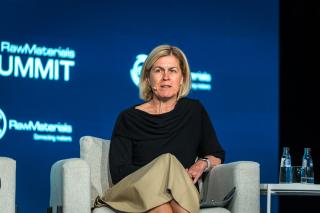
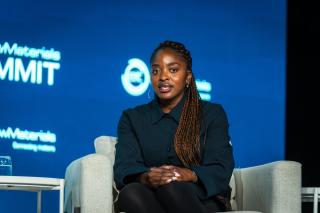
Op-Ed by Naaja H. Nathanielsen, Greenland's Minister for Business, Trade, Mineral Resources, Justice and Gender Equality
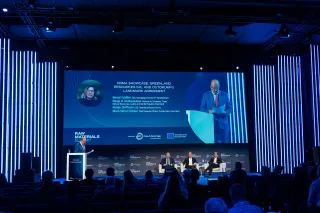
Naaja H. Nathanielsen joined via video call at the EIT RawMaterials Summit 2025.
In a world shifting from globalism to regionalism, partnerships with like-minded countries are more important than ever. We need allies to tackle both current and future challenges, and this holds true for both Greenland and the European Union.
Greenland, a country rich in natural resources, has powerful potential to become a cornerstone in Europe's supply of critical raw materials. As an indigenous people, we are deeply connected to nature and demand high standards when it comes to environmental considerations, and Europe's stringent environmental and governance benchmarks align with our own ambitions to develop responsible mining.
In 2023, the European Union and Greenland signed a Memorandum of Understanding (MoU) for a strategic partnership on raw materials, formalising our shared commitment to establishing critical raw materials value chains that feed directly into Europe and its industrial ecosystems. Yet, a crucial piece has been missing: translating these shared political ambitions into tangible mineral initiatives that directly support and de-risk concrete projects.
Currently, the burden of high-risk, long-term investments in mining falls predominantly on project owners. To truly unlock Greenland's potential as the initial link in this vital supply chain, we must develop instruments to de-risk these crucial early stages. This is particularly important for Greenland, a small economy that cannot independently co-fund a major mining sector.
While our royalty models acknowledge the added costs of infrastructure, a gap persists between the desire for business and the imperative to connect countries that share fundamental values – a discrepancy that, in these geopolitically unstable times, demands urgent attention.
The EIT RawMaterials Summit in May offered a compelling example of what is possible. We celebrated the 10-year offtake agreement between Greenland Resources, a Canadian mining company developing the Malmbjerg project in East Greenland, and Outokumpu, Europe’s largest stainless steel producer. This landmark deal to secure a long-term, low-emission supply of molybdenum from Greenland is more than a commercial contract - it is a strategic signal of Greenland’s growing role in supporting European resilience.
For Greenland, this agreement marks a pivotal step in our journey to become a modern and responsible mining nation. It demonstrates our capacity to deliver high-quality resources, developed with unwavering environmental stewardship, rigorous national oversight, and robust local engagement.
While this agreement focuses on molybdenum, Greenland possesses significant untapped potential for other vital minerals such as rare earth elements, graphite, lithium, and nickel – all indispensable for Europe's green and digital transitions. With the right support and strategic collaboration, these resources can become central to a diversified and secure European supply chain.
Greenland stands ready to be a reliable, responsible partner in building Europe’s resilient raw materials future. Together, we can turn shared ambitions into a blueprint for sustainable resource partnerships.
Naaja H. Nathanielsen is Greenland's Minister for Business, Trade, Mineral Resources, Justice and Gender Equality. This article is based on her remarks at the EIT RawMaterials Summit on 15 May in Brussels.