The silicon solution: How E-magy is building Europe's battery independence
Backed by EIT RawMaterials, Dutch scale-up E-magy is replacing Chinese graphite with locally produced silicon, strengthening Europe’s battery supply chain while boosting battery performance.

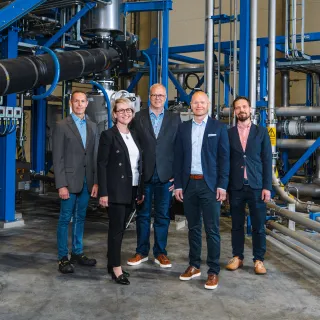
E-magy patented casting machine
In most lithium-ion batteries today, graphite is the main active anode material. More than 90% of battery-grade graphite refining takes place in China1. As Europe races to build its own gigafactory ecosystem and secure a homegrown battery supply chain, that dependency is impossible to ignore.
E-magy, a Dutch advanced materials company, has spent years engineering a way out. The company has developed a nanoporous silicon anode material capable of replacing graphite in lithium-ion batteries. Its material delivers up to 40% higher energy density, and charging speeds up to three times faster than conventional graphite anodes.
The case for silicon goes beyond performance. Silicon is the second most abundant element in the Earth's crust2, widely available and cost-effective. Crucially, E-magy sources its silicon locally within Europe and manufactures it using a patented process at its facility in the Netherlands.
Following funding of €1 million through the EIT RawMaterials KAVA Call earlier this year, E-magy is now scaling its industrial pilot plant to a capacity of 50 tonnes per year by 2028, enough to support 0.4 GWh of battery capacity. The investment will accelerate early market adoption in applications such as drones and consumer electronics, while laying the groundwork for broader deployment across the electric mobility sector.
"With the support of EIT RawMaterials, we can further industrialise our nanoporous silicon anode technology and strengthen Europe's battery materials supply chain. Producing advanced anode materials locally is essential for reducing emissions, improving supply security, and enabling the next generation of batteries," said Casper Peeters, CEO of E-magy.
From research startup to commercial reality
Founded in 2019, E-magy draws on silicon crystallisation technology developed through more than two decades of advanced materials research at ECN, now part of TNO, the Netherlands' leading applied research institute.
Since then, E-magy has evolved from a research-focused company into a commercially driven business preparing for industrial scale-up. "A couple of years ago, we were mostly an R&D company. Today, we have a really well-established commercial team that can turn an idea into a product that can be sold to mass markets, and that's definitely what EIT RawMaterials helped us with,” Peeters said.
That commercial progress has attracted significant investor backing. In 2023, E-magy raised €20.5 million from a mix of industrial, impact and venture capital investors, including Hydro, Invest-NL, Rubio, SHIFT Invest and PDENH, to expand production capacity.
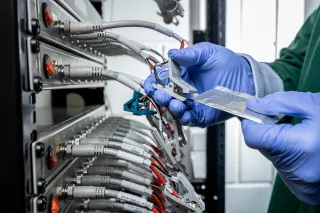
ENS30 ( E-magy product) tested in battery cell format
A drop-in solution for battery manufacturers
Part of E-magy’s appeal lies in how easily its technology can be integrated into existing battery manufacturing processes. The company's high-performance silicon powder is designed as a “drop-in” solution, meaning battery manufacturers can incorporate it directly into existing anode production lines without replacing costly equipment. That compatibility could significantly accelerate adoption.
EIT RawMaterials has also played a key role in helping E-magy build its presence within the European battery ecosystem.
"When it comes to exposure to the European market, EIT RawMaterials has helped us build the right connections and the right relationships," Peeters added. The company frequently participates in EIT RawMaterials events, including the EIT RawMaterials Summit 2026, where it has pitched to investors and industry partners during Investor Day and showcased its technology at the Innovation Village.
“E-magy combines breakthrough battery performance with a scalable industrial model, which is exactly the kind of innovation needed to strengthen Europe’s battery competitiveness,” said Coen de Vos, Business Development Manager at EIT RawMaterials. “We are proud to support E-magy’s growth and to see it progress from promising innovation to real industrial deployment.”
E-magy’s technology is already being tested in advanced solid-state batteries, widely considered one of the most promising next-generation technologies for electric vehicles. Looking ahead, the company’s long-term ambition is to scale production capacity to a level capable of supplying silicon anode material for more than one million electric vehicles annually.
Do you have an innovative solution in the raw materials industry and want to receive funding? Check out our Kava Upscaling Call here.
Find out more about EIT RawMaterials’ supported startups in our startup portfolio