n9ve: From End-of-Life Magnets to Virgin-Grade Rare Earths
With support from EIT RawMaterials, Portuguese startup n9ve is transforming end-of-life wind turbine magnets into high-purity rare earth oxides, helping build a more secure and circular European supply chain for critical raw materials.

Every wind turbine reaching the end of its working life contains something Europe desperately needs: rare earth elements, locked inside the permanent magnets that drive the generator. A single 10 MW direct-drive turbine holds around 6.5 tonnes of NdFeB magnets — roughly 2 tonnes of rare earths. Europe currently imports 98% of these materials, almost entirely from China, and as the continent accelerates its wind repowering programmes and electric vehicle rollout, the supply problem will only get more acute.
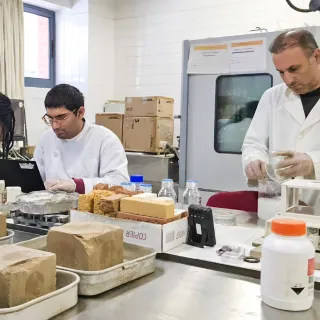
n9ve, a Portuguese startup funded by EIT RawMaterials, is working to change that. The company has developed a patented hydrometallurgical process to recover rare earth elements from end-of-life permanent magnets, and its pre-industrial prototype is already producing rare earth oxides at over 99% purity, at a cost more than 50% below current market prices.
EIT RawMaterials’ funding helped bring together a pan-European consortium that includes SE&C IKE from Greece, Galp, Portugal's largest energy company, Enercon from Germany, and the National Institute of Chemistry from Slovenia.
Recovery over recycling
n9ve's approach sets it apart from most rare earth projects currently active in Europe. While many focus on what the industry calls "short-loop" recycling — making new magnets directly from old ones — n9ve works on the "long loop": breaking down end-of-life magnets into their elemental components and recovering the rare earths themselves in pure oxide form.
Our product is the same as what comes from a mine. It’s completely pure — you can use it to make a new magnet stronger than the one before.
José Pinheiro-Torres, CEO, n9ve
Short-loop recycling tends to degrade the material with each cycle, whereas n9ve's process resets to zero each time, meaning the recovered oxides can go into any application, not just back into magnets.
Securing a reliable supply of end-of-life magnets is just as important as developing the technology itself. n9ve works with OEMs, wind farm operators, maintenance companies and decommissioning partners to source defective and retired permanent magnets, with Enercon already serving as its first industrial reference as the company expands into offshore wind.
"The challenge is bringing all the stakeholders together and turning this material into a real European supply chain," José says.
n9ve is a great example of the innovation taking place in Portugal today. Portugal may be a relatively small country, but it is producing companies with global ambitions and technologies that can contribute directly to Europe's strategic autonomy in critical raw materials.
Ana Carina Verissimo, Business Development Manager, EIT RawMaterials
From algae to rare earths
José didn't set out to solve Europe's rare earth problem. In 2018, while researching an unrelated project at a Portuguese university, a professor showed him a paper on algae as a natural sorbent for rare earth elements — and that was the first time he had heard of rare earths at all. From there, he spent years experimenting, pivoting, and pushing the science further than most thought it could go, including contracting Denmark's DTU to test a protein-based method for selective separation of rare earth elements.
"They thought it was a crazy idea — they thought it was not going to work, but they were willing to try," he says. It worked, and alongside a hydrometallurgical recovery process developed with a Portuguese university, it forms the technological foundation of what n9ve is building today.
EIT RawMaterials gave us the push we needed at the right moment. We had the technology, the ambition, and the conviction. EIT gave us the speed, credibility, and European partners to prove that rare earth recovery from end-of-life magnets is not only possible, but that it can become a real European supply chain.
José Pinheiro-Torres, CEO, n9ve
The road to industrial scale
A larger, fully automated pilot plant is due to reach full capacity by the end of 2026, with full industrial-scale production planned for 2027, processing 500 tonnes of end-of-life magnets each year.
Alongside this, n9ve is seeking recognition as a Strategic Project under the EU's Critical Raw Materials Act, which aims for Europe to source 25% of its annual strategic raw materials consumption from recycling by 2030. The company has also applied for an EIC Pathfinder grant to further develop its protein-based extraction technology — the once unlikely idea from the DTU experiments that could eventually prove as significant as its hydrometallurgical process.
Longer term, n9ve plans to move beyond producing rare earth oxides into alloys and, ultimately, a new generation of high-performance permanent magnets — a market that has seen little innovation since the 1980s and remains overwhelmingly dominated by China.
"China dominates production and has no incentive to innovate," José says. "But we do."
Find out more about how EIT RawMaterials can fund your project through the Kava Call
Read more success stories here